The quoted price is never the price paid
FOB, EXW, DDP, free or invoiced samples, tooling on whose account: two quotes "at $4.20" can be 40% apart in reality. Without normalization, comparing them means nothing.

You negotiate with forty factories and the facts get lost in the chat. Paste the thread — SourceRadar pulls out prices, MOQs, lead times and certifications, scores how reliable each supplier has actually been, then tells you what margin is genuinely left.
One-time $9.99 · No subscription · No account to create
A serious launch means fifty to a hundred suppliers contacted. Three weeks in, nobody remembers who said what.
FOB, EXW, DDP, free or invoiced samples, tooling on whose account: two quotes "at $4.20" can be 40% apart in reality. Without normalization, comparing them means nothing.
A supplier promises a certificate by Monday, never sends it, and nobody flags it. That is the single most predictive signal of what production will look like.
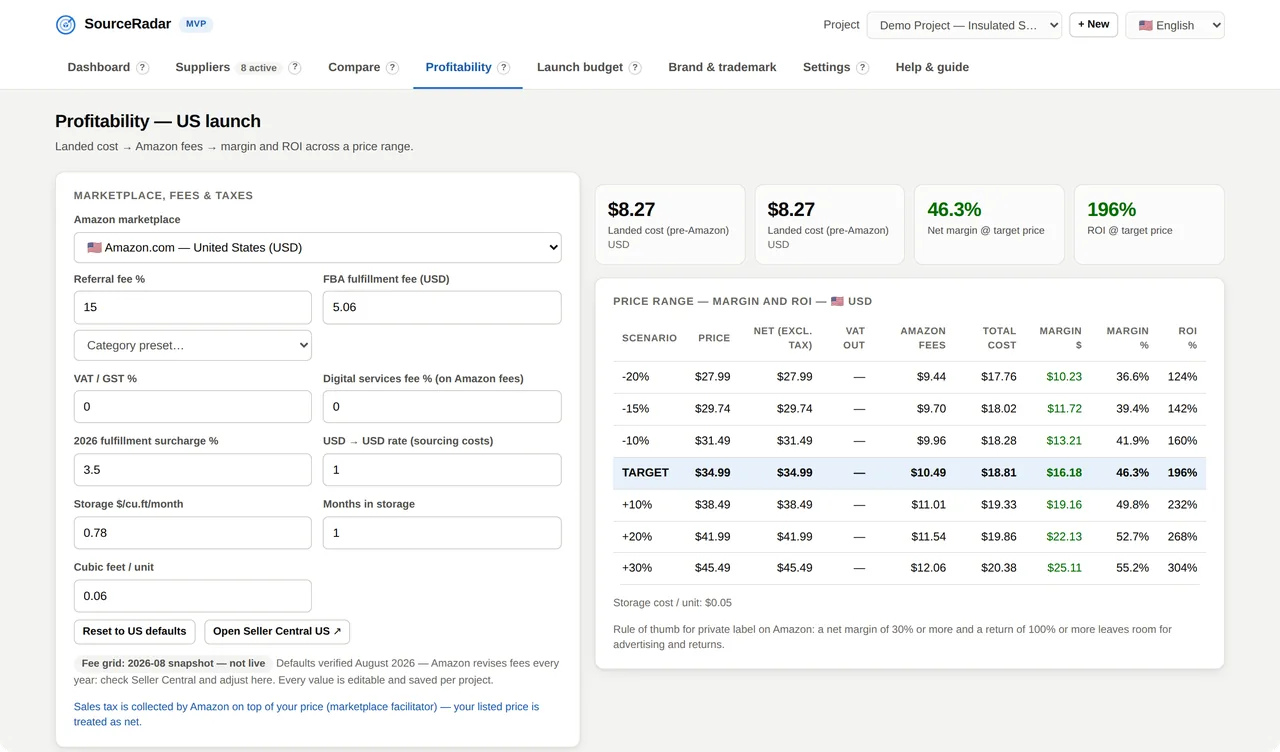
Referral fees, FBA, storage, freight, duty, import VAT: they are rarely added up before negotiating. The highest acceptable unit price should be known before the first message goes out.
Seven screens, one thread: turning conversations into decisions you can defend.
Copy a whole conversation — Alibaba, Made-in-China, Global Sources, email. The app identifies the speakers, isolates the supplier's messages and produces a structured record: tiered pricing, announced and negotiated MOQ, production lead time, incoterm, payment terms, certifications, samples.
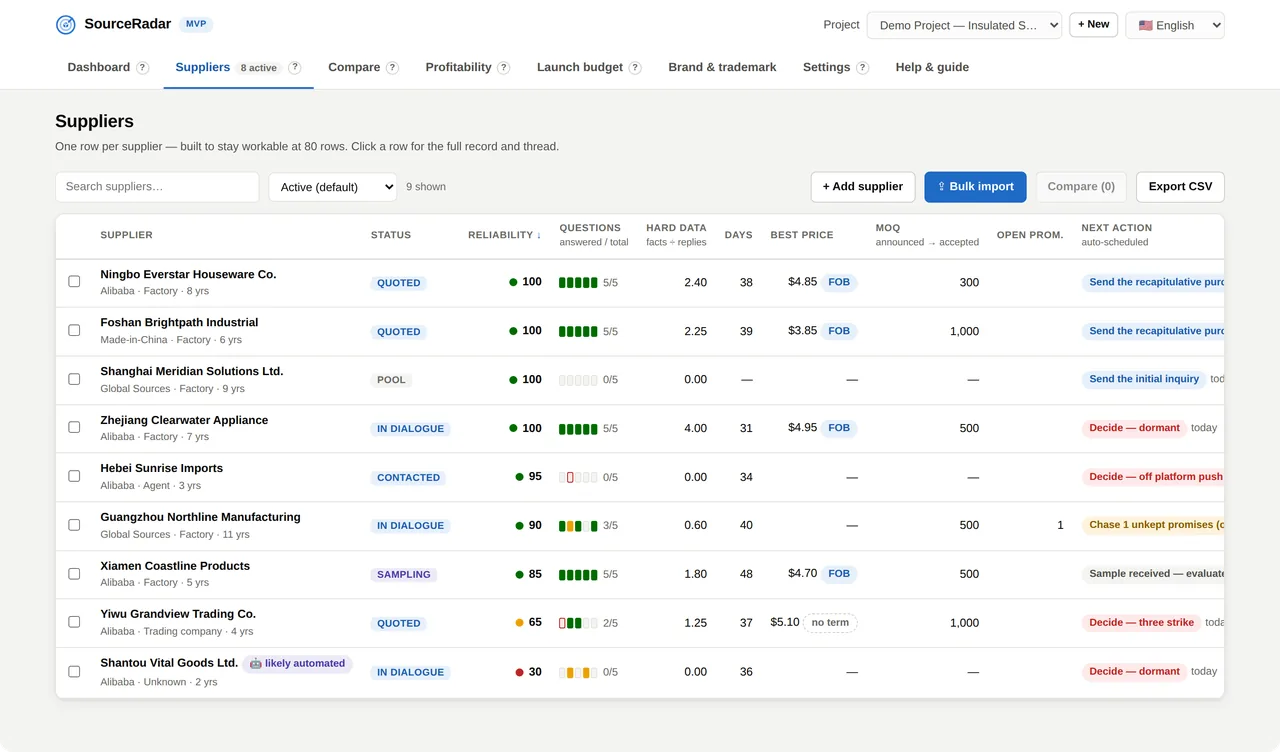
The score is not a gut feeling. It aggregates observable facts: base questions still unanswered after three substantive replies, dated promises not kept, contradictions between messages, pressure to leave the secured channel, ratio of hard data per reply.
Put three finalists side by side on identical terms: landed cost at your warehouse, not factory price. Incoterm, tooling and sample differences are folded back in, which frequently reshuffles the ranking.
A dated, editable Amazon fee grid across 23 marketplaces, shipping size tier and weight, storage fees, duty, VAT. You get the maximum acceptable unit price and the break-even point before you write to the supplier.
Deposit, balance, freight, inspection, photography, launch advertising, and the cash curve up to your first Amazon payout. This is where most first launches break — not on margin, on payment timing.
Track every step of a trademark filing, from clearance search to registration, with links to the official offices. A brand-name generator runs on device, with no key required.
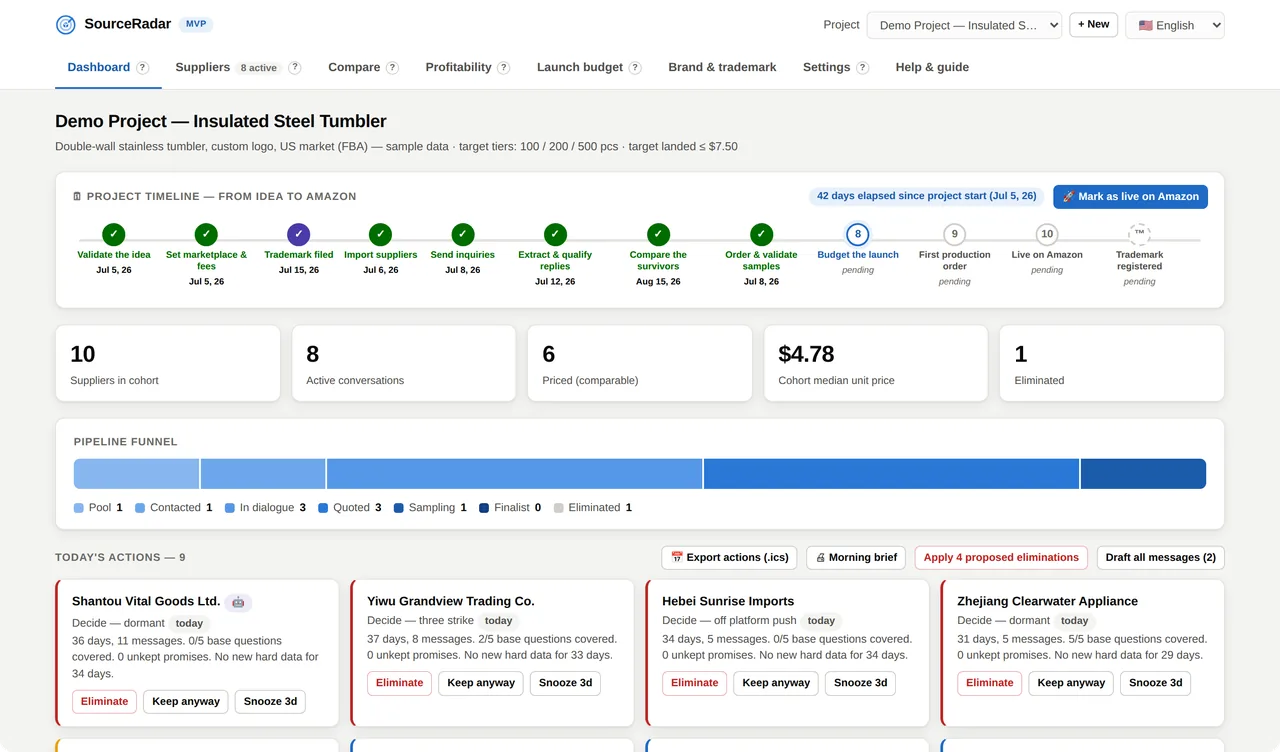
Today's actions, ranked by genuine urgency.
One row per factory, scored on verifiable facts.
Landed cost, Amazon fees, break-even, ceiling price.
One conversation, ten conversations, an exported file. No manual entry, no spreadsheet to keep alive.
Each supplier becomes a comparable record with a dated next action: chase, request the sample, eliminate, send the recap purchase order.
Three finalists, one landed cost per unit, one margin, one budget. The call takes ten minutes instead of three evenings.
A supplier thread holds your buying prices, your volumes and your margins. That is the most sensitive data a seller owns, and it has no business sitting on someone else's server.
The app opens and works. There is nothing to create, therefore nothing to breach.
No analytics, no advertising, no tracker, no crash reporter. We receive nothing because there is nothing to receive.
If you add your own Anthropic key — and only then — the text being processed goes from your device to the API. No key is bundled; the app is complete without one.
Your projects are yours: one file, on your disk, that you reopen wherever you like.
Sourcing tools charge between $30 and $100 a month. This one is paid once, and nothing stops working if you pause your project for six months.
No in-app purchases, no subscription, no upsell prompts.
No, deliberately. No sourcing platform exposes a buyer messaging API, and automated access to your private session can get your account suspended. You copy the conversation; the app handles the cleaning and extraction.
No, on purpose. The grid is a dated snapshot, labelled as such in the Profitability tab, and every value stays editable. A tool that claims "live" fees without delivering them is more dangerous than one that is honestly dated.
No. The app is complete without one. An optional AI assist becomes available if you add your own Anthropic key in Settings, for extraction from very messy text and for brand-name generation.
Because your suppliers read English. The interface language is for you; messages meant for factories stay in professional English whatever language you work in.
Yes, entirely. All computation is local. A connection only matters for opening external links or, if you enabled it, for the AI assist.
Not automatically, which follows from having no server. JSON export lets you carry a project from one device to another, or hand it to a partner.
No. The app is built for private label: negotiating a custom-made product with MOQs, samples, tooling and certifications. For resale, most of its features would sit unused.
There is no official relationship. SourceRadar is an independent tool for sellers who use the Fulfillment by Amazon programme. It was not created or endorsed by Amazon.
Our second tool, built on the same principles: one-time purchase, no data on our servers, an interface that gets to the point. Quotes signed on site, invoices in thirty seconds, scheduling and payment reminders.
Nine dollars ninety-nine, once. Compare that to the cost of a single bad supplier.